
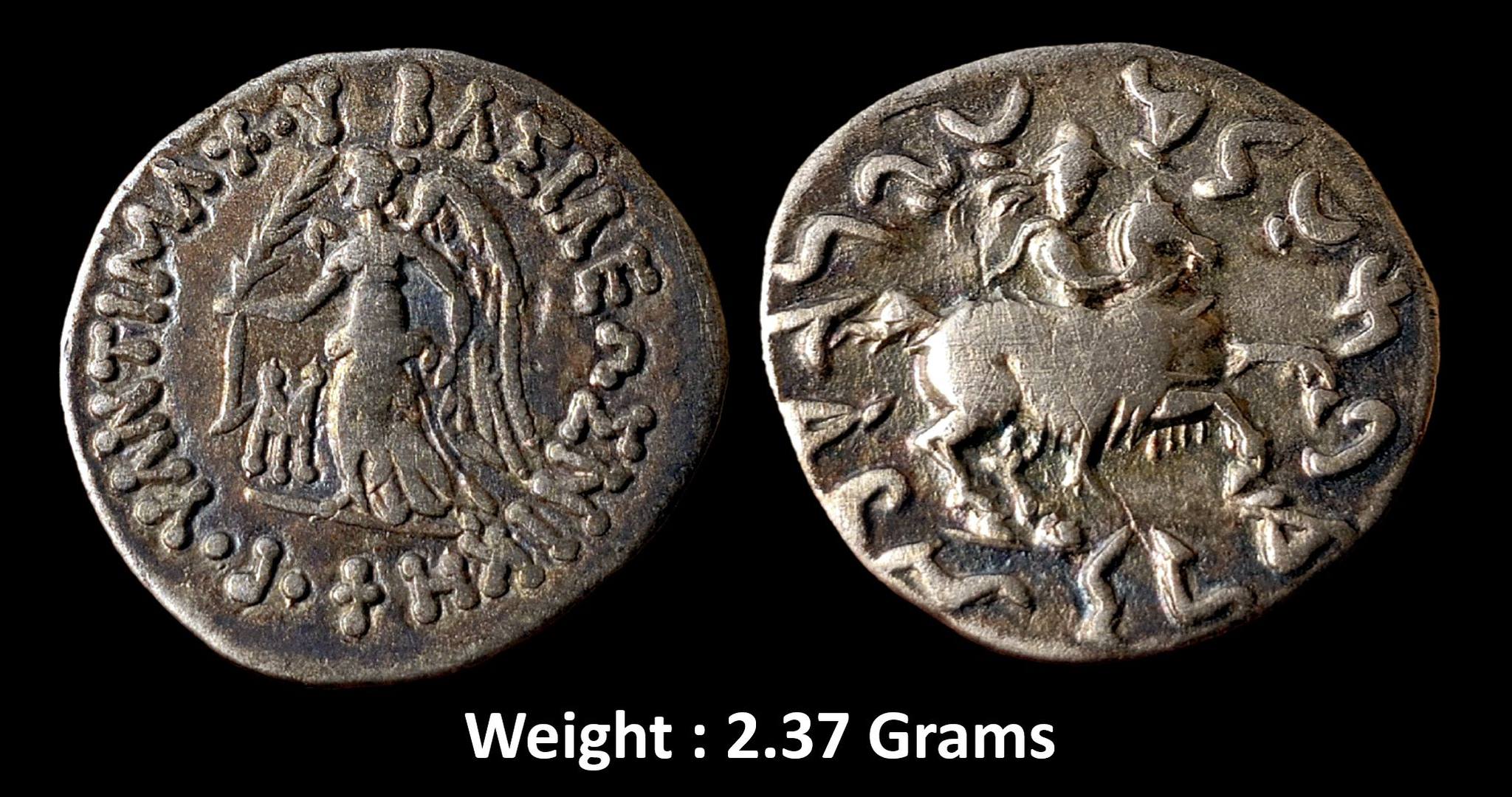
Ancient India ; Indo-Greek ; Antimachus II, 174 – 165 BCE ; Denomination: Silver Drachm
Ancient India ; Indo-Greek ; Antimachus II,
174 – 165 BCE ; Denomination: Silver Drachm
Out of stock
Description
Ancient India ; Indo-Greek ; Antimachus II,
174 – 165 BCE ; Denomination: Silver Drachm ;
Weight: 2.37 grams ;
Condition: Extremely Fine+, in its natural state of preservation with complete legends seen on-flan on both Obverse & Reverse, high relief, beautifully toned & patinated, it’s so crisp clear that even the facial features of goddess Nike along with the most intricate details of the legends & devices are all seen crystal clear which is rarely seen,
Rarity: Rare with such Deep & sharp strike
Attribution: Bopearachchi & Rahman # type 218.
Obverse: Winged Goddess Nike standing to left, holding wreath (fillet) & palm branch, monogram on left field.
Greek legend around: BAΣIΛEΩΣ NIKHΦOPOY ANTIMAXOY i.e. BASILEOS NIKEPHOROU ANTIMACHOU
Reverse: Horseman (King riding horse as he’s clearly seen wearing the diadem on his head displaying his royal status), horse galloping (prancing) to right.
Kharoshthi legend around: MaHaRaJaSa JaYaDhaRaSa AmTiMaKaSa
P.S: Antimachus II was a rough contemporary of Apollodotus I (c. 174 – 165 BCE).
Antimachus II issued only two coin types one in silver & another in bronze in only two specific types & denominations in each of the metals. One of the very few rulers in Indo-Greek Kingdom who didn’t use his own portrait on his coins as compared to the rest of the rulers in the same series. The reason for him not striking coins with his own portrait can easily be concluded with the fact since this was not a custom indigenously in India during that time. Neither did the early kings strike Tetradrachms.
Antimachus II struck bilingual Drachms on the same lighter Indian standard as Apollodotus I, though round in shape. On the obverse is Nike, and on the reverse, a king on horseback.
Antimachus II Nikephoros (Greek: Ἀντίμαχος Β΄ ὁ Νικηφόρος; the epithet means “the Victorious”) was an Indo-Greek king. He ruled a vast territory from the Hindu-Kush to the Punjab region around 170 BCE. He was almost certainly the eponymous son of Antimachus I, who is known from a unique preserved tax receipt. Bopearachchi dated Antimachus II to 160 – 155 BCE on numismatical grounds, but changed this to 174 – 165 BCE after the tax receipt was revealed to synchronise his reign with that of Antimachus I. R. C. Senior has not dated Antimachus II but thinks that his coins were possibly Indian issues of Antimachus I, despite their different epithets and coin types.
In both of Boperachchi’s reconstructions, Antimachus II was succeeded by Menander I who inherited three of his four monograms. Antimachus II probably fought against the Bactrian king Eucratides I, who had dethroned his father in Bactria.
Additional information
| Denomination | |
|---|---|
| Material |
Silver |
| Weight |
2.37 |
| Shipping Charges |
100 |









Reviews
There are no reviews yet.