
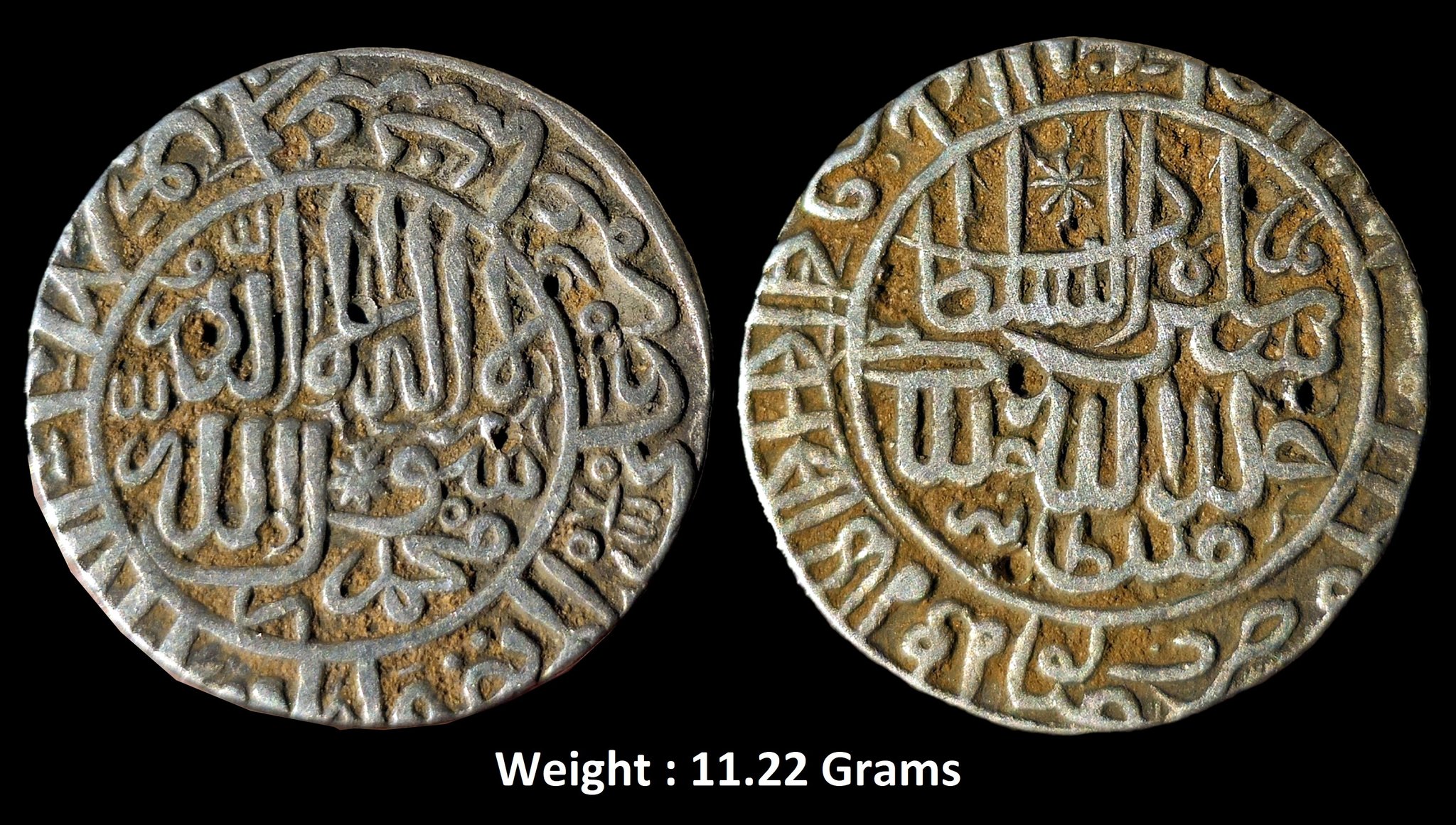
Delhi Sultan ; Sher Shah Suri ; Silver Tanka Mint : Chunar ; 949 AH
₹13,500.00
Delhi Sultan ; Sher Shah Suri ; Silver Tanka
Mint : Chunar ; 949 AH
1 in stock
Description
Delhi Sultan ; Sher Shah Suri ; Silver Tanka
Mint : Chunar ; 949 AH ; Weight : 11.22 Grams
From the reverse margin : Al-Sultan al-Adil (obverse margin) Farid al-Dunya wa al-Deen Abu al-Muzaffar (obverse center field) Sher Shah al-Sultan Khallad Allah Mulkuhu.
The mint and date are inscribed in the obverse margin with Devanagari inscription Shri Ser Sahi. The reverse center field has the Shahadah and the margin has the names of the first four Caliphs of Islam as: Abu Bakr al-Siddique, Umar, Uthman and Ali al-Murtadha.
Note : The fortress of Chunar is situated on the eastern bank of Ganges in the modern day Mirzapur district of Uttar Pradesh (U.P.) India. During the times of Sher Shah Suri when he was a fief holder and part of the court of Babur, Chunar formed the western frontier of the Afghan holdings in Southern Bihar.
Taj Khan Sarang Khani, was the muqta (fief-holder) of Chunar under Ibrahim Lodhi. After the battle of Panipat, Taj Khan entered the service of Babur and was able to preserve his status as the muqta of Chunar. Taj Khan Sarang Khani died in 1530 CE, and a struggle for the control of his holdings (iqtas) started between two rival factions. One of these factions was headed by Lad Malika, the favorite wife of Taj Khan, while the other consisted of the sons of Taj Khan from his other wives. Sher Khan was able to exploit the situation and secure the hand of Lad Malika in marriage. Sher Shah subsequently quelled the opposition of Taj Khan’s sons and became the master of Chunar while also coming in possession of considerable wealth. The fortress of Chunar became Sher Shah’s main military base and its possession marks a turning point in his rise from a fief holder in Bihar to the Sultan of Delhi.
After the death of Babur towards the end of the year 1530 CE, the Afghans rebelled in Bihar headed by Mahmud Lodhi (son of the deceased Sultan Sikander Lodhi) and supported by the Sultan of Bengal Nasir al-Din Nasrat Shah. The Mughal emperor Humayun marched towards Bihar in 1531 CE to crush the rebellion. At the battle of Daurah, the Mughal army triumphed over the Afghan rebels and the Afghan leaders including Mahmud Lodi were slain. There are conflicting reports about the participation of Sher Shah Suri in the Afghan rebellion. Whatever the case may be, Humayun subsequently marched to Chunar and demanded that Sher Shah surrender the fort. Sher Shah declined Humayun’s orders and leaving his son Jalal Khan (the future Suri monarch Islam Shah) in charge of the fort fled towards Rohtas. Humayun laid siege to the fort of Chunar at the beginning of the year 1532 CE which lasted for about four months. Once it became evident that the fort would fall, Sher Shah submitted to Humayun sending his son Qutb Khan (as a hostage) to the Mughal court, while retaining the possession of Chunar. Even though Sher Shah had to submit to the Mughal emperor, his defense of Chunar against the Mughal army and his continued possession of Chunar gave him the reputation of an able military leader and strategist.
Sher Shah lost possession of Chunar in 1537 when Humayun attacked Chunar as a consequence of Sher Shah’s invasion of Bengal in the same year. The strategic value of Chunar can be gauged by the fact that when Humayun sued for peace prior to the battle of Chaunsa, Sher Shah accepted the terms with the sole condition that the fortress of Chunar should be given back to him. However, Humayun declined Sher Shah’s demand and an accord could not be reached. After the battle of Chaunsa in 1539 CE, Chunar was reoccupied by Suri forces, which formed the western outpost of Sher Shah’s Sultanate of Bihar and Bengal.
The earliest rupees from Chunar are recorded for the year 948 AH (1541-42 CE), after the battle of Qanauj that interrupted Mughal rule in India and made Sher Shah the first Suri Sultan of Delhi. Chunar continued as an active Suri mint during the subsequent reigns of Islam Shah and Muhammad Adil Shah.
Additional information
| Denomination | |
|---|---|
| Material |
Silver |
| Weight |
11.22 |
| Shipping Charges |
70 |


Reviews
There are no reviews yet.