
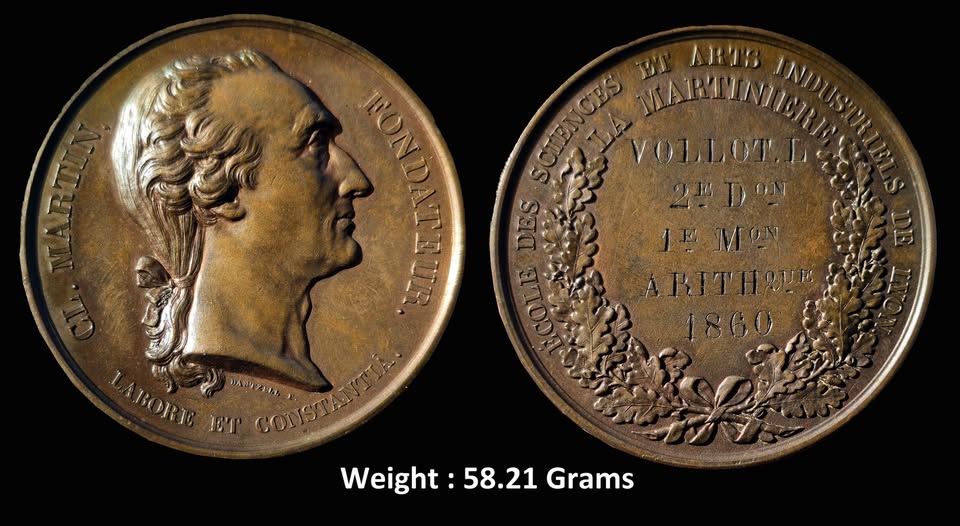
Medal ; France ; Major General Claude Martin (1735-1800 AD) ; Bronze Medallion
Medal ; France ; Major General Claude Martin (1735-1800 AD) ; Bronze Medallion
Out of stock
Description
Medal ; France ; Major General Claude Martin (1735-1800 AD) ; Bronze Medallion ; Obv: bust of claude martin right, lettering around ‘CL. MARTIN FONDATEUR, LABORE ET CONSTANTIA, below his neck ‘DANTZELL F.’ ; Rev: legend and wreath, unnamed, letters engraved ‘CUIVRE’, 58.21g, 50.87mm, (Puddester # 836.3.2) ; Extremely Fine ; Rare ;
Note : Claude Martin was born on 5 January 1735 in the rue de la Palme, Lyon, France. He was the son of Fleury Martin (1708–1755), a casket maker, and Anne Vaginay (1702–1735), a butcher’s daughter. At his local parish school he excelled in mathematics and physics. After leaving school he was apprenticed to a local silk weaver.Martin’s family were middle class and by this time they had businesses in mustard, vinegar and brandy. His decision to go into the silk yarn business did therefore not go down well with his family.
In 1751 at the age of 16 Martin decided to seek his fortune abroad, and he signed up with the French Compagnie des Indes.His mother is reported to have said that he should not return from enlisting as a soldier until he was “in a carriage”.He was posted to India where he served under Commander and Governor Joseph François Dupleix and General Thomas Arthur Lally in the Carnatic Wars against the British East India Company. When the French lost their colony of Pondichéry in 1761, he accepted service in the Bengal Army of the East India Company in 1763, ultimately rising to the rank of Major General.
He was initially employed at the then-new Fort William in Calcutta, Bengal, and afterwards on the survey of Bengal under the English Surveyor General James Rennell. In 1776, Martin was allowed to accept the appointment of Superintendent of the Arsenal for the Nawab of Awadh, Asaf-ud-Daula, at Lucknow, retaining his rank but being ultimately placed on half pay.He resided in Lucknow from 1776 until his death. It was the ‘Reign of Terror’ during the French Revolution that prevented him from returning “in a carriage”.His friend, Antoine Polier, gave up his wives and children, as he left India to return France. Polier was stabbed to death in a criminal assault during the aforesaid revolution. Martin never formally gave up his nationality as a Frenchman, but definitely intended to, towards the end of his life, as he sought promotions in the Bengal Army.
Martin was born in Lyon, France, into a humble background, and was a self-made man who left a substantial lasting legacy in the form of his writings, buildings and the educational institutions he founded posthumously. There are now ten schools named after him, two in Lucknow, two in Calcutta and six in Lyon. The small village of Martin Purwa in Lucknow was also named after him.
Additional information
| Material |
Copper |
|---|---|
| Weight |
58.21 |
| Shipping Charges |
100 |





Reviews
There are no reviews yet.